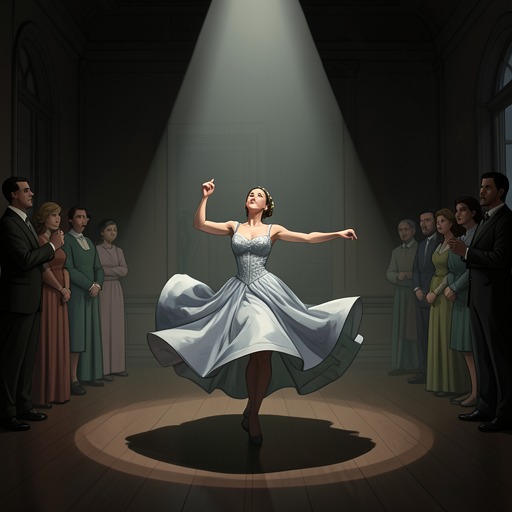
Chloe Masters
SCOTTISH ROMANCE: My Sinful Surrender to a Highlander Werewolf (Scottish Werewolf Pregnancy Romance) (Historical Medieval Shape Shifter Paranormal Science Fiction Short Stories)Chloe Masters is introduced as a curvaceous dancer whose public image conceals a determined and intellectually directed young woman. Her decisive significance lies in the collision between her earthly ambitions and a cosmic system that treats human selection, sexuality, and reproduction as matters of organized study. What begins as a side job undertaken to finance veterinary training becomes the gateway to abduction, alien incorporation, pregnancy, and a radically altered definition of belonging.
Identity and Ambition
Chloe works in a club because dancing pays more than the alternatives available to her and allows her to pursue college training as a veterinarian. She describes herself as a natural beauty rather than a manufactured one, emphasizing that her body is fuller than the thin, standardized figures around her but not unhealthy. At 5 feet 9 inches and 170 pounds, with piercing green eyes and long blond hair, she has learned to turn the very features that invite judgment into professional advantages. Her confidence is not effortless: she recalls being an ugly duckling and a tomboy who copied the boys partly to prove that she was more than people assumed. Her earlier dream of becoming the first female president gives way to a more focused desire to care for animals, while dancing remains a financially necessary and emotionally complicated temporary occupation.
Chloe’s relationship to performance is therefore double-edged. She resents the club’s judgmental hierarchy and refuses to let Jessica provoke an altercation that could cost her employment, but she also admits that performing before an excited audience gives her an inward thrill. The stage is not merely degradation or mere liberation; it is a place where she consciously manages spectatorship, bodily difference, money, and self-definition. Her refusal to accept the label of the “stick thin Barbie dolls” makes bodily self-acceptance one of her clearest forms of resistance.
Selection and Abduction
After a private dance, Chloe receives a $100 tip from a mysterious man who identifies himself as Rolf. Soon afterward, a high-pitched sound overwhelms her, leaving her on her knees, dizzy and nauseated. A bright, warm light surrounds her and lifts her from the ground. Rather than presenting the experience as immediate terror, the narration stresses her strange sense of safety and her failure to resist, a response that makes the abduction feel dreamlike even as its physical consequences become unmistakable. When she regains her bearings, Earth is receding through the ship’s viewfinder and Rolf is standing before her in space.
Rolf explains that Chloe has won a lottery conducted across the cosmos. At least 100,000 women were considered, and he claims that three years of searching were required to find someone who met every criterion. His language exposes the selection’s dehumanizing structure: Chloe is an ideal candidate, expected to learn the alien culture and speak on behalf of her master. She immediately rejects the designation and asks to be returned, even suggesting that Jessica would be a more willing substitute. Rolf dismisses Jessica as too artificial and too thin to survive the planet’s atmosphere, while praising Chloe’s wholesome quality and the hidden fire he believes he can uncover.
The scene places Chloe between agency and captivity. She is outspoken enough to reject Rolf’s authority, yet the circumstances deny her meaningful consent to the journey. Her body, personality, appearance, and presumed reproductive capacity have been evaluated by an unseen institution before she knows that the institution exists. The lottery therefore transforms the familiar pressures of the entertainment industry into a cosmic version of the same logic: Chloe is watched, ranked, chosen, and rewarded according to criteria controlled by others.
Alien Relationship and Pregnancy
The selection becomes a sexual and reproductive arrangement. Rolf continues having sex with Chloe daily, and she later discovers that she is pregnant with his child. He intends to raise the child back on Earth, and the authorities to whom he answers grant permission for the pair to attempt a normal life. Chloe is required to remain on the alien world until the pregnancy is complete, while their sex life is to be kept private and away from observers. The arrangement thus combines surveillance, institutional approval, reproductive experimentation, and a promise of domestic normality.
Chloe’s response is not presented as a simple escape from coercion. She acknowledges the strangeness of conceiving a child with an alien, but she also reasons that the aliens regard her as an alien herself, making the boundary less decisive to her. Her bodily difference, once a source of judgment on Earth, becomes part of the reason she is valued in the new society. The language of being pampered and treated like royalty further reverses her previous position: the dancer who had been assessed by customers is now celebrated as a unique interspecies specimen, though that celebration remains inseparable from the system that selected and confined her.
The pregnancy changes the meaning of the assignment for both partners. What began as Rolf’s search for a suitable candidate becomes, in Chloe’s understanding, a shared domestic future. She says that her needs are being fulfilled, that she has the man of her dreams, and that a child is on the way. The reproductive experiment is consequently recast as a love story, but the underlying power imbalance never disappears: Rolf’s superiors authorize the pregnancy, determine the conditions of Chloe’s stay, and permit the couple’s proposed return to Earth.
Transformation and Ending
Chloe’s movement from nightclub performer to interstellar mother is an abrupt transformation rather than a gradual social ascent. She leaves behind the college and veterinary future she had been trying to build, yet she carries her defining qualities with her: physical self-possession, verbal resistance, curiosity, and a capacity to make an imposed role into something she can interpret on her own terms. Even when Rolf tells her that she will learn to accept what he has chosen for her, her earlier refusal shows that she has not become passive. The narrative instead makes her adaptation the source of its final reversal.
The ending presents Chloe as pregnant and remaining on the alien world while the authorities study the human-alien relationship through the possibility of a normal family life. She understands the relationship as having moved beyond an assignment, concluding that love has emerged between them. Her ending is therefore both fulfillment and unresolved compromise. She receives care, status, sexual satisfaction, and a promised child, but these gains arise from abduction and a reproductive system in which others first defined her value. Chloe’s story turns the “winner” of a cosmic lottery into a figure who exposes the ambiguity of reward when the prize is inseparable from captivity, experimentation, and the surrender of an earlier life.